
Types of Bolts: What Are the 20 Main Bolt Types, Head Styles and Uses?
A buyer-friendly guide to 20 types of bolts — hex, structural, flange, carriage, socket, stud, eye, U and anchor bolts — with head types, ISO/DIN/ASTM standards and uses.
The Short Answer
There are about 20 bolt types in everyday industrial use, and almost all of them can be sorted by two things: the head (how you turn it and how it bears on the joint) and the shank (fully threaded, partly threaded, headless or bent). The hex bolt is the default for machinery and general assembly; heavy hex structural bolts carry steel buildings; carriage bolts fasten wood; socket head bolts go where there is no room for a spanner; studs, eye bolts, U-bolts and anchor bolts cover flanges, lifting, pipes and foundations.
Each type below lists the standard it is usually bought to (ISO, DIN or ASTM/ASME), what it is used for, and — where we stock it — a link to the matching product page.
Key Takeaways
- About 20 bolt types cover nearly all industrial joints; they split into 5 families: hex-head, socket-head, square-neck, headless and special-shape bolts.
- The same bolt often has 2–3 standard numbers — e.g. DIN 931 and its successor ISO 4014 for a partial-thread hex bolt, DIN 912 and ISO 4762 for a socket head cap screw. Check details: DIN and ISO hex bolts differ in across-flats at M10, M12, M14 and M22.
- Steel-structure bolts are their own category: ASTM F3125 (Grade A325 / A490) in North America, EN 14399-4 (DIN 6914) HV bolts in Europe — they are not interchangeable with ordinary hex bolts.
- Strength is set mainly by the grade (4.8 to 12.9 metric, SAE Grade 2/5/8), not the bolt type; the finish (zinc, zinc-nickel, HDG) sets how long it lasts outdoors.
Bolt Types at a Glance
| # | Bolt type | Head / drive | Typical standards | Typical use |
|---|---|---|---|---|
| 1 | Hex bolt (partial thread) | Hex, spanner | DIN 931 / ISO 4014, ASME B18.2.1 | Machinery, general assembly |
| 2 | Full-thread hex bolt (hex cap screw) | Hex, spanner | DIN 933 / ISO 4017, SAE J429 | Tapped holes, short clamp lengths |
| 3 | Heavy hex structural bolt | Heavy hex | ASTM F3125 (A325 / A490), EN 14399-4 | Steel buildings, bridges |
| 4 | Tension control (TC) bolt | Round head, spline tip | ASTM F3125 F1852 / F2280 | Steel structures, fast installation |
| 5 | Hex flange bolt | Hex with built-in washer | DIN 6921 / EN 1665, ISO 4162 | Automotive, sheet metal, vibration |
| 6 | Square head bolt | Square, spanner | ASME B18.2.1, DIN 478 | Rail, agriculture, heritage designs |
| 7 | Socket head cap screw | Cylindrical, hex key | DIN 912 / ISO 4762, ASME B18.3 | Dies, moulds, compact machinery |
| 8 | Button head socket bolt | Low dome, hex key | ISO 7380-1 | Guards, covers, exposed heads |
| 9 | Countersunk socket bolt | 90° flat head, hex key | DIN 7991 / ISO 10642 | Flush surfaces |
| 10 | Shoulder bolt | Socket head, ground shoulder | ISO 7379 | Pivots, guides, linkages |
| 11 | Carriage bolt | Round mushroom head, square neck | DIN 603 / ISO 8677, ASME B18.5 | Timber, fencing, trailers |
| 12 | Plow bolt | Countersunk, square neck | DIN 608, ASME B18.9 | Wear parts on farm and earthmoving kit |
| 13 | Elevator bolt | Large thin head, anti-rotation neck or lugs | DIN 15237 | Conveyor belts, bucket elevators |
| 14 | Stud bolt | No head, threaded both ends | ASTM A193 B7, ASME B16.5 lengths | Pipe flanges, pressure vessels |
| 15 | Tap-end stud | No head, two thread lengths | DIN 938 / 939 / 835 | Engine blocks, pump housings |
| 16 | Threaded rod | No head, threaded full length | DIN 975, ASTM A307 / A193 | Hangers, cut-to-length studs |
| 17 | Anchor bolt (J / L bolt) | Bent end, cast into concrete | ASTM F1554 | Column bases, foundations |
| 18 | U-bolt | U-shape, two threaded legs | DIN 3570 | Pipes, axles, round sections |
| 19 | Eye bolt | Forged ring | DIN 580 | Lifting points |
| 20 | Wheel bolt | Hex or flange head, OE seat | To OE drawing | Trucks, trailers, cars |
Hex-Head Bolts: The Default Choice
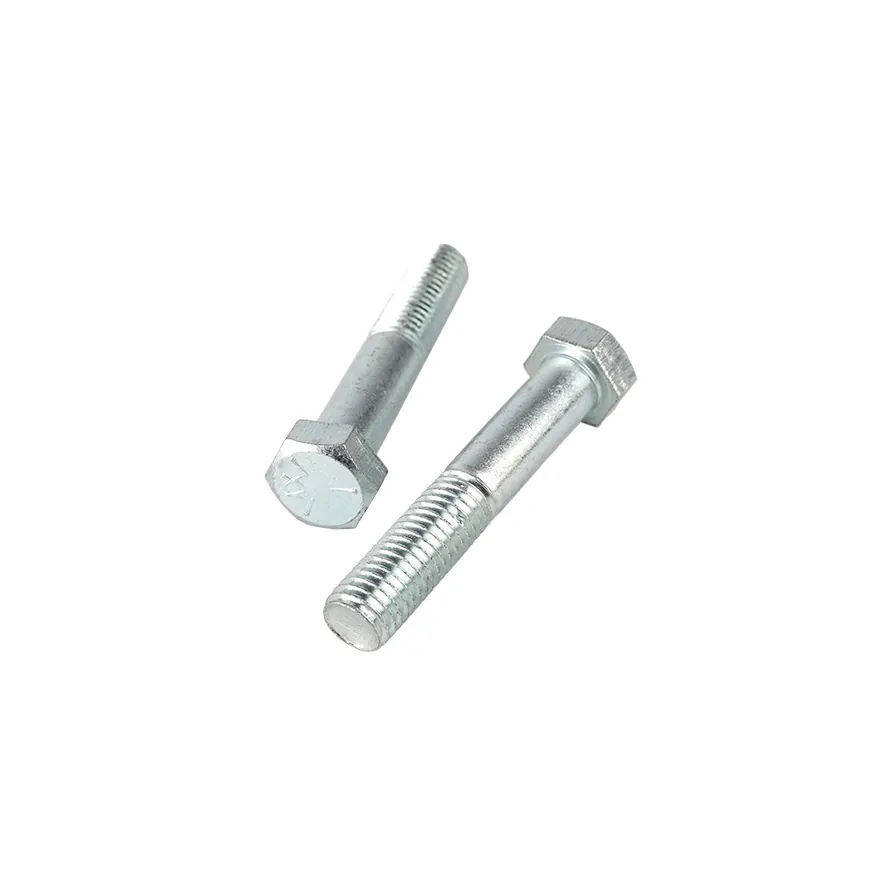
1. Hex bolt (partial thread). The most common bolt in the world: six-sided head, plain shank under the head and thread only at the end. The plain shank sits in the shear plane of the joint, which is why hex bolts are preferred for clamped plates. Metric hex bolts are bought to DIN 931 or its successor ISO 4014 — nearly the same part, but the across-flats width differs at M10, M12, M14 and M22 (M10 is 17 mm under DIN 931 and 16 mm under ISO 4014), so state which one your spanners and drawings assume. Inch hex bolts are bought to ASME B18.2.1. See our hex bolts range (M5–M36, grades 4.8 to 12.9) or the DIN 931 hex bolt page.
2. Full-thread hex bolt (hex cap screw). Same head, threaded right up to the head. Use it in tapped holes and short grip lengths. Metric: DIN 933 / ISO 4017 (DIN 933 full-thread hex bolt). Inch: SAE J429 Grade 5 and Grade 8 hex cap screws. Fine-pitch versions (DIN 960 / DIN 961) are used where vibration or adjustment matters.
3. Heavy hex structural bolt. Larger head across flats and a shorter thread than a standard hex bolt, so it bears on the steel and resists stripping under pretension. In North America these are ASTM F3125 Grade A325 (120 ksi) and Grade A490 (150 ksi); the old stand-alone A325 and A490 specs were replaced by F3125, first published in 2015. In Europe the equivalent system is EN 14399-4 (DIN 6914) HV bolts in grade 10.9. Structural bolts are sold as matched sets with their nuts and hardened washers. See structural bolts.
4. Tension control (TC) bolt. A structural bolt with a round head and a splined tail. A shear wrench twists the spline off at a set torque, giving a visible sign that the tightening step was completed on each bolt. The spline breaking is not proof of correct pretension on its own: lubrication and condition matter, and RCSC practice still calls for pre-installation verification of each lot in a tension calibrator. Bought to ASTM F3125 Grade F1852 (A325 strength) or F2280 (A490 strength); see the tension control bolt page.
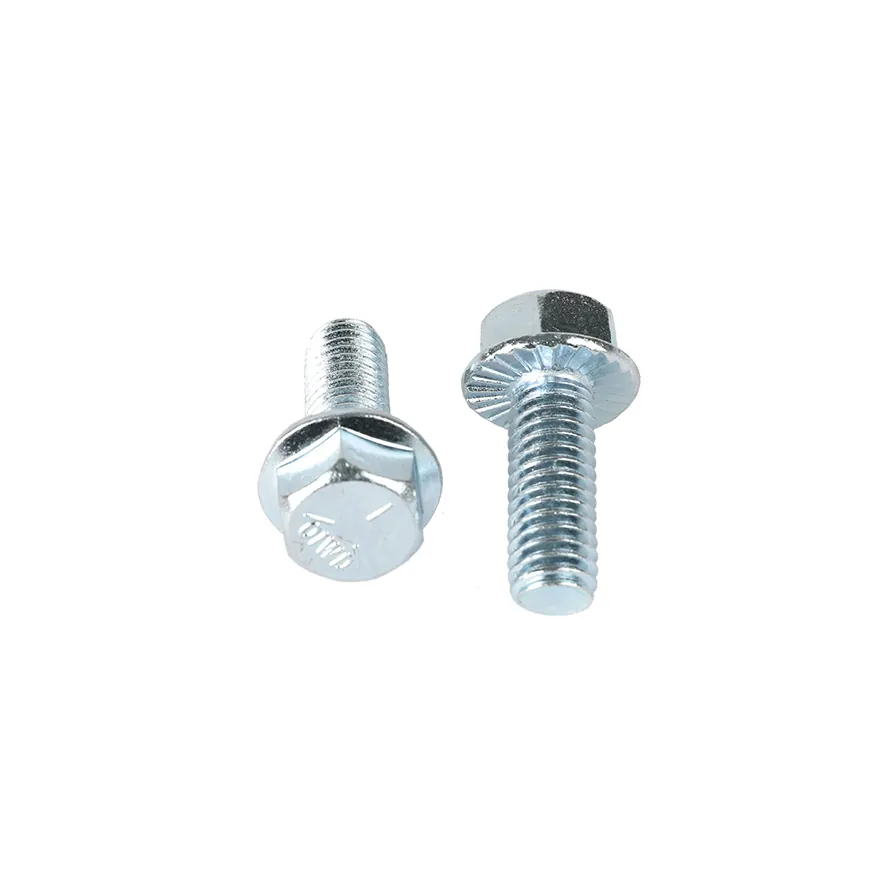
5. Hex flange bolt. A hex head with an integrated washer face, often serrated to resist loosening. It spreads load on thin sheet and saves one part per joint, which is why it is standard in vehicle and appliance assembly. Metric: DIN 6921, replaced by EN 1665; ISO 4162 covers the small-series version with a smaller flange. See flange bolts.
6. Square head bolt. The oldest head style; four flats give a bigger grip for a spanner and a large bearing face. Still specified in rail track work, agricultural machinery and restoration jobs (ASME B18.2.1, DIN 478 for the collared version).
Socket-Head Bolts: When There Is No Room for a Spanner
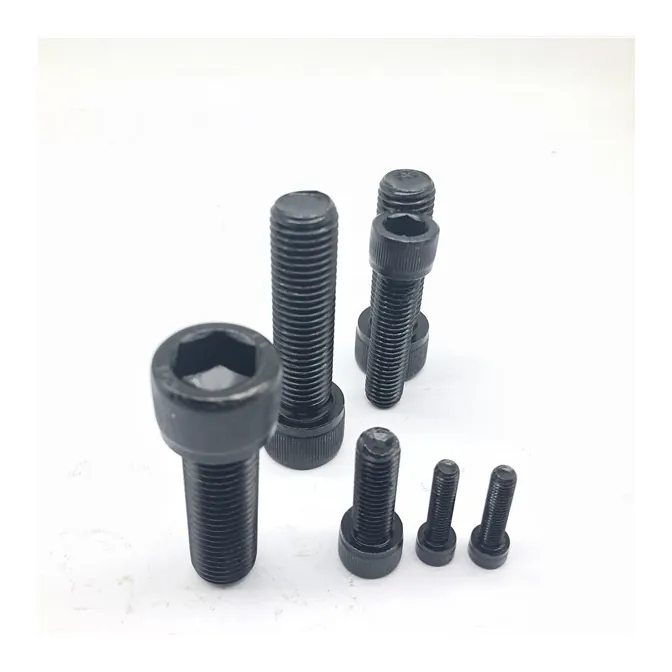
7. Socket head cap screw. A tall cylindrical head driven by a hex key. The compact head lets bolts sit close to walls and inside counterbores, so these are standard in tooling, moulds and machine frames, usually in grade 12.9. Metric: DIN 912 / ISO 4762; inch: ASME B18.3. See socket head cap screws.
8. Button head socket bolt. A low, rounded head (ISO 7380-1) that looks tidy and has no sharp edge — used on guards, covers and consumer products. It carries less torque than a cap screw, so it is rarely sold above grade 10.9. See the ISO 7380 button head screw.
9. Countersunk (flat head) socket bolt. A 90° conical head that sits flush in a countersunk hole: DIN 7991 / ISO 10642. Used wherever a protruding head would catch or interfere. See countersunk socket bolts.
10. Shoulder bolt. A socket head over a precision-ground plain shoulder and a short thread (ISO 7379). The shoulder acts as an axle for pivots, rollers and linkages.
Sourcing several bolt types for one project?
Send one list with standard, size, grade and finish for each line. We quote mixed orders from 500 pcs per size and reply within 24 hours.
Send Your Bolt List →Anti-Rotation Neck Bolts: Wood, Wear Parts and Belts
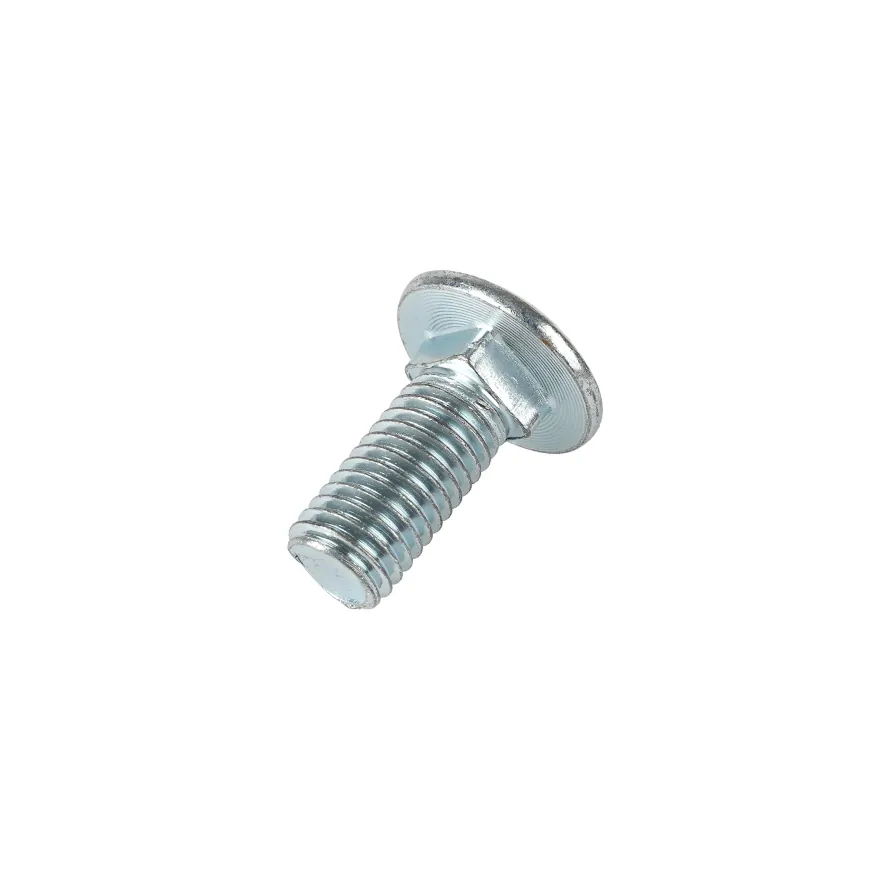
11. Carriage bolt. A smooth round (mushroom) head over a square neck. The neck bites into wood or a square hole so the bolt cannot turn while the nut is tightened from the other side — and the smooth head cannot be undone from outside. Used in timber framing, fencing, playgrounds and trailer decks. Metric: DIN 603 / ISO 8677; inch: ASME B18.5. See carriage bolts.
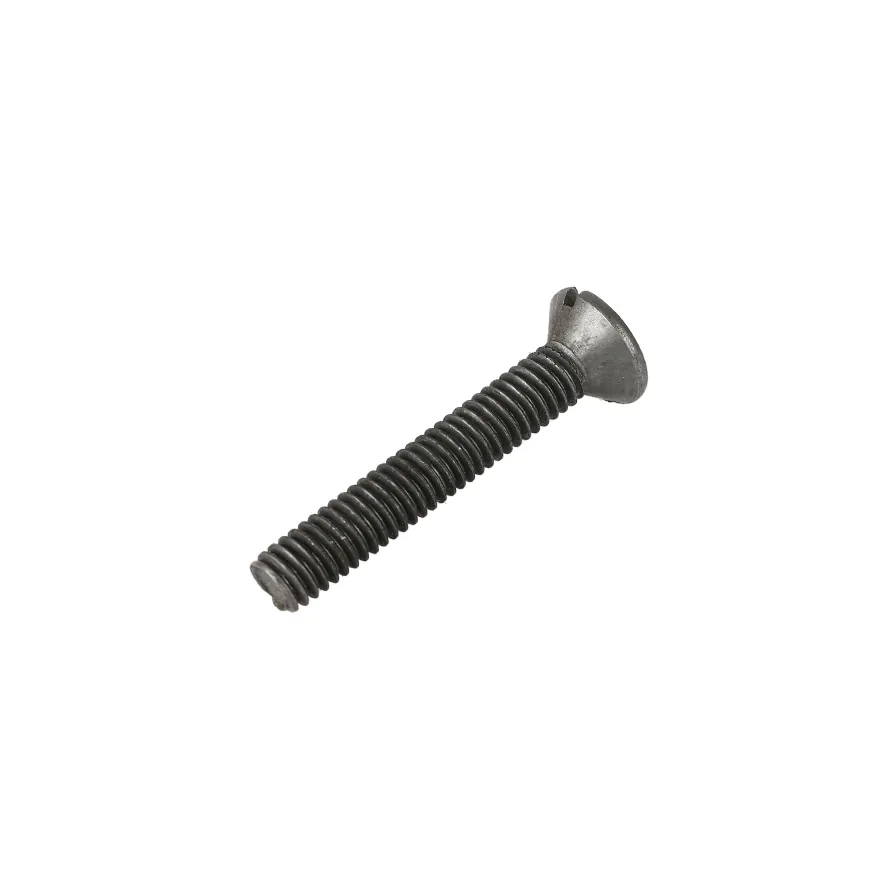
12. Plow bolt. A countersunk head with a square neck, so it sits flush in the replaceable cutting edges and wear plates of ploughs, graders and buckets. Inch plow bolts are ASME B18.9; metric versions follow DIN 608. See the plow bolt page.
13. Elevator bolt. A very large, thin head with an anti-rotation neck or lugs underneath, designed to sit low against conveyor and bucket elevator belts without tearing them. Head shape varies by standard — DIN 15237 belt bolts use a dished head with lugs — so match the bolt to the bucket and belt maker's specification.
Headless Bolts: Studs and Threaded Rod
14. Stud bolt. A rod threaded at both ends (or full length) used with two nuts, typically on pipe flanges and pressure vessels. The standard material pairing is ASTM A193 Grade B7 studs with ASTM A194 Grade 2H heavy hex nuts, cut to the lengths in ASME B16.5. See stud bolts.
15. Tap-end stud. One end screws permanently into a tapped hole, the other takes a nut. The tap-end length is set by the material it goes into: DIN 938 (1 × d, steel), DIN 939 (1.25 × d, cast iron) and DIN 835 (2 × d, aluminium). See DIN 938 / 939 tap-end studs.
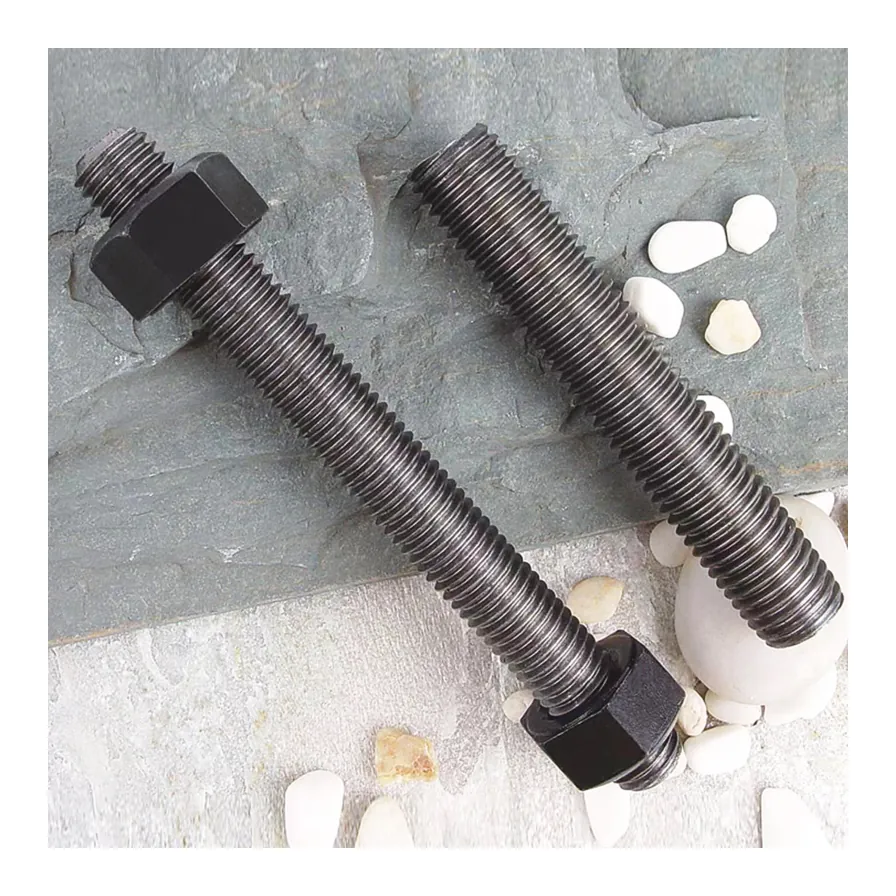
16. Threaded rod. Threaded along its full length (DIN 975 metric; ASTM A307 or A193 B7 inch) and cut to length on site — for ceiling hangers, anchors and long through-bolts. See threaded rods.
Special-Shape Bolts: Foundations, Pipes and Lifting
17. Anchor bolt (J-bolt, L-bolt). A rod with a bent or headed end cast into concrete to hold column base plates and machinery. In the US these are bought to ASTM F1554 in Grade 36, 55 or 105 (the number is the minimum yield strength in ksi).
18. U-bolt. A rod bent into a U with both legs threaded, used to clamp pipes, tubes and leaf springs to axles (DIN 3570 for pipe U-bolts).
19. Eye bolt. A bolt with a forged ring for lifting. Use only forged, load-rated eye bolts to DIN 580 for lifting, and check the reduced rating for angled pulls; bent-wire eye bolts are for light rigging only.
20. Wheel bolt. A high-strength bolt (typically grade 10.9) with a specific seat — flat, conical or spherical — that must match the wheel. Wheel bolts are made to the vehicle maker's drawing, not a generic standard. See wheel bolts and wheel nuts.
Bolt Head Types Compared
The head decides which tool you need, how much load spreads onto the joint and whether the bolt sits proud or flush.
| Head type | Tool | Bearing area | Sits | Best for |
|---|---|---|---|---|
| Hex | Spanner / socket | Medium | Proud | General use, high torque |
| Heavy hex | Spanner / socket | Large | Proud | Structural steel, pretensioned joints |
| Flange (hex + washer) | Spanner / socket | Large | Proud | Thin sheet, vibration |
| Square | Spanner | Large | Proud | Rail, agricultural, heritage |
| Socket cap (cylindrical) | Hex key | Small | Proud or counterbored | Tight spaces, high strength |
| Button | Hex key | Medium | Low profile | Covers, guards, appearance |
| Countersunk (flat) | Hex key or square neck | Conical | Flush | Smooth surfaces, wear plates |
| Round / mushroom | None (square neck locks it) | Large | Proud, smooth | Wood, tamper resistance |
| Eye (ring) | None | — | Proud | Lifting |
How to Specify the Right Bolt Type
Choosing the type is step one. A purchase order also needs four more fields, and missing any one of them is the most common reason quotes come back wrong:
Standard and size. Give the standard number and the thread size and length, e.g. "DIN 933 M12 × 50" or "ASME B18.2.1 1/2-13 × 2". Our DIN vs ISO vs ASTM fastener standards guide lists the common equivalents.
Grade. Metric 4.8, 8.8, 10.9 or 12.9; inch SAE Grade 2, 5 or 8; stainless A2-70 or A4-80. The bolt grades guide explains what each number means in MPa.
Finish. Plain, black oxide, zinc, zinc-nickel, hot-dip galvanized (HDG) or zinc flake. For outdoor and under-vehicle use, finish matters as much as grade. On our own line, zinc-nickel at 12 µm reaches 1,000 hours of neutral salt spray to first red rust and 1,440 hours at 15 µm — see zinc-nickel vs zinc plating and HDG vs zinc-nickel vs Dacromet. Note that HDG bolts need nuts tapped oversize to fit the thicker coating.
Quantity per size. Quotes depend heavily on volume per size, not total weight.
| What you know | What to send | Example |
|---|---|---|
| Standard part | Standard + size + grade + finish + qty | DIN 931 M16 × 120, 8.8, zinc-nickel, 5,000 pcs |
| Inch part | Dimensional std + grade + size + thread length + finish + qty | ASME B18.2.1 hex cap screw, SAE J429 Gr 8, 3/8-16 × 1-1/2 full thread, zinc yellow, 10,000 pcs |
| Non-standard part | Drawing (PDF/DWG) + material + finish + qty | Wheel bolt to OE drawing, 10.9, black Zn-Ni |
| Not sure of the type | Photo with a ruler + where it is used | Sample bolt from an existing machine |
Buying Bolts in Bulk from Ningbo
ZNiBolt supplies bolts, nuts, screws and washers from Ningbo, China, in metric sizes M3–M48 and inch sizes #6 to 1-1/2" (larger on request), to DIN, ISO, ASTM/ASME, SAE, EN, JIS or your drawing. Zinc and zinc-nickel finishes are done on our own line; HDG, zinc flake and mechanical galvanizing are also available. Standard terms: MOQ 500 pcs per size (negotiable for trial orders), 15–25 days lead time for standard parts (finishes such as HDG or Dacromet add a few days), FOB Ningbo, CIF or DDP.
Not every bolt type in this guide is in our catalogue. For the types without a product link (eye bolts, U-bolts, anchor bolts, shoulder bolts, elevator bolts), send a drawing or sample and we will confirm whether we can supply them before quoting. Request a bolt quote or browse all fastener categories.
FAQ
What are the most common types of bolts?
Hex bolts (DIN 931 / ISO 4014 and DIN 933 / ISO 4017) are by far the most common, followed by carriage bolts, socket head cap screws, flange bolts and threaded rod. In construction, heavy hex structural bolts to ASTM F3125 or EN 14399 are the main type.
What is the difference between a bolt and a screw?
In general terms, a bolt passes through a clearance hole and is tightened with a nut, while a screw threads into the material or a tapped hole. In practice standards blur the line — a "hex cap screw" and a "full-thread hex bolt" can be the same part — so always order by standard number, not by name. Full comparison: bolt vs screw.
How do I identify a bolt head type?
Look at the tool it takes and its profile: six flats = hex; six flats with a built-in washer = flange; a round socket for an Allen key = socket cap, button or countersunk; a smooth dome with a square neck underneath = carriage bolt. Measure the across-flats width or head diameter to confirm the standard.
Is a lag bolt a bolt?
Not in the strict sense. A lag bolt (lag screw, ASME B18.2.1) has a hex head like a bolt but a pointed, coarse wood thread, so it screws directly into timber without a nut. It belongs to the screw family.
Which bolt type is strongest?
Strength comes mainly from grade and diameter. A grade 12.9 socket head cap screw (1,220 MPa minimum tensile strength) is stronger than a grade 8.8 hex bolt of the same size, but low heads matter: ISO 7380 button head and ISO 10642 countersunk screws have reduced head loadability, so they should not replace a cap screw in a fully loaded joint. Among structural bolts, ASTM F3125 Grade A490 structural bolts (150 ksi) are stronger than Grade A325 (120 ksi).
Looking for zinc-nickel plated fasteners?
Request a sample for your project. Reply within 24 hours.
Request a Sample →