
Bolt vs Screw: What Is the Difference and Which Do You Need?
Bolt vs screw explained: a bolt goes through a hole and is tightened with a nut; a screw threads into the part. Comparison table, grey areas like hex cap screws, and how to choose.
The Short Answer
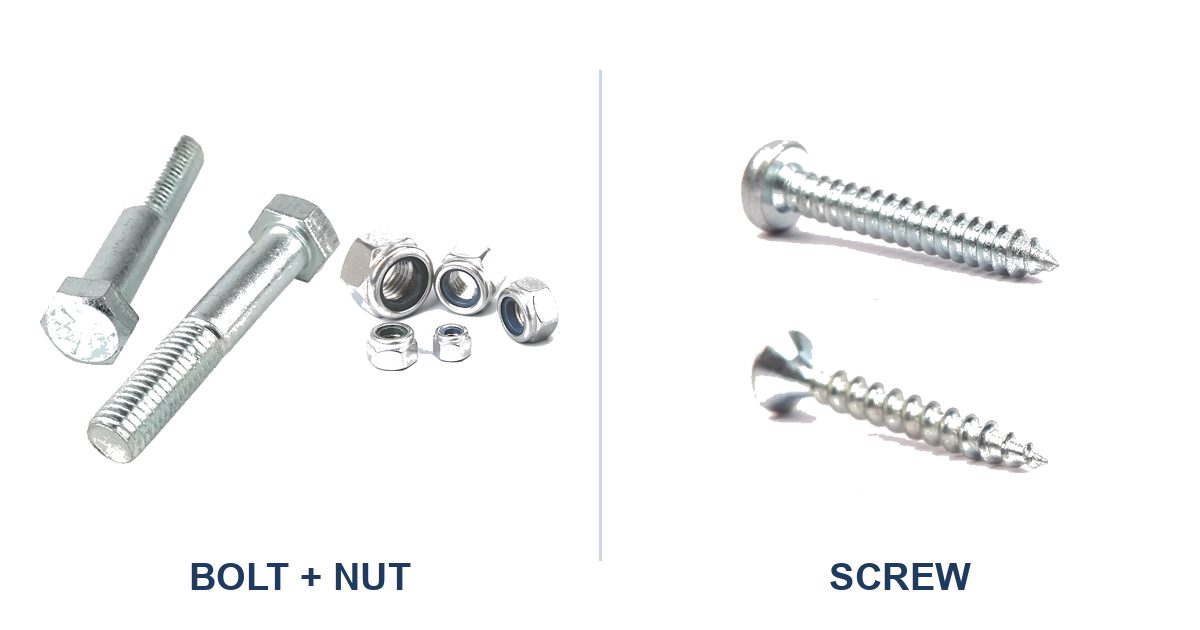
A bolt passes through clearance holes in the parts it joins and is tightened by turning a nut. A screw threads into one of the parts — either into a pre-tapped hole or by forming its own thread in wood, sheet metal, plastic or concrete — and is tightened by turning its head. That is the definition used in the American fastener standards (ASME B18.2.1 includes a guide for distinguishing between bolts and screws), and it is the practical test most engineers use: *what does it thread into, and which part do you turn?*
The shape alone does not decide it. The same hex-head part can be a bolt in one joint and a screw in another, which is why buyers should always order by standard number, size and grade rather than by the word "bolt" or "screw".
Key Takeaways
- Bolt = through-hole + nut, you turn the nut. Screw = threads into the part, you turn the head.
- Bolts usually have a blunt end and a machine thread; many screws (wood, self-tapping, self-drilling, concrete) have a pointed or drill tip and a coarse thread-forming thread.
- Grey areas are common: a full-thread hex bolt (DIN 933 / ISO 4017) is officially a "hexagon head screw", and a socket head cap screw (DIN 912 / ISO 4762) is often used with a nut.
- Metric property classes 4.8 to 12.9 (ISO 898-1) apply to bolts, screws and studs alike — strength is set by grade and diameter, not by the name.
- Choose by the joint: access to both sides and a shear load → bolt and nut; blind hole or one-side access → screw.
Bolt vs Screw at a Glance
| Bolt | Screw | |
|---|---|---|
| How it holds | Clamps parts between head and nut | Threads into one of the parts |
| What you turn | The nut (head is held) | The head |
| Hole needed | Clearance hole through all parts | Tapped hole, pilot hole or none (self-drilling) |
| Thread | Machine thread (metric or UNC/UNF) | Machine thread, or coarse thread-forming / thread-cutting |
| Tip | Blunt, chamfered | Blunt (machine screws) or pointed / drill point |
| Shank | Often a plain shank under the head (partial thread) | Usually threaded close to the head |
| Typical standards | DIN 931 / ISO 4014, ASTM F3125, DIN 603 | DIN 7985 / ISO 7045, DIN 7981 / ISO 7049, DIN 7504 |
| Removal | Easy and repeatable — the nut takes the wear | Repeated removal can wear a thread in soft materials |
| Typical use | Steel structures, machinery, flanges, trailers | Housings, sheet metal, wood, panels, concrete fixing |
What Makes a Bolt a Bolt
A bolt is designed to be installed through aligned holes and tightened by a nut on the other side. Turning the nut stretches the bolt slightly, and that stretch is what clamps the joint (the preload). Three features usually follow from that job:
A plain shank. A partial-thread hex bolt such as the DIN 931 / ISO 4014 hex bolt has an unthreaded section under the head. When plates try to slide past each other, the smooth shank — not the thread roots — sits in the shear plane, which is why partial-thread bolts are specified for shear joints.
A blunt end and a standard machine thread so it can take a standard hex nut (DIN 934 / ISO 4032 in metric, ASME B18.2.2 in inch).
Access to both sides of the joint — one tool on the head, one on the nut.
Common bolts: hex bolts, heavy hex structural bolts, carriage bolts (the square neck stops the bolt turning, so you only need a tool on the nut), U-bolts and stud bolts. Our guide to 20 types of bolts covers each one with its standard.
What Makes a Screw a Screw
A screw is tightened by turning its head and gets its hold from the thread inside the part. There are two big families:
Screws that go into a tapped (pre-threaded) hole. Machine screws such as DIN 7985 / ISO 7045 pan head and DIN 965 / ISO 7046 countersunk screws (M2.5–M8), and socket head cap screws for engine blocks, moulds and machine frames. They have a normal machine thread and a blunt end — the only difference from a bolt is where the internal thread lives.
Screws that make their own thread. Self-tapping screws (DIN 7981 / ISO 7049) form a thread in a pre-drilled hole in sheet metal or plastic; self-drilling screws (DIN 7504) drill the hole and tap it in one step; chipboard and wood screws cut into timber and panels; concrete screws cut a thread directly into a drilled hole in concrete. These are case-hardened at the surface (ISO 2702 for tapping screws), so they are not graded 8.8 or 10.9 like bolts — their job is to be harder than the material they cut.
The Grey Areas: Hex Cap Screws, Socket Cap Screws and Lag Bolts
This is where most bolt vs screw confusion — and most wrong orders — come from.
Hex bolt vs hex cap screw. In the metric system, ISO 4014 (old DIN 931) is called a "hexagon head bolt" and has a partial thread; ISO 4017 (old DIN 933) is called a "hexagon head screw" because it is threaded up to the head. In practice both are used with nuts and in tapped holes. In the inch system (ASME B18.2.1), a *hex cap screw* is made to tighter tolerances than a *hex bolt*, with a washer face under the head and a chamfered point, so it can be used either with a nut or in a tapped hole. SAE J429 Grade 5 and Grade 8 parts are normally sold as hex cap screws. If your drawing says "hex bolt" but the part goes into a tapped hole, a full-thread DIN 933 / ISO 4017 part is usually what you need.
Socket head cap screw. Called a screw (DIN 912 / ISO 4762), but often used with a nut in through holes. Same story: the name comes from the standard, not the joint. See socket head cap screws.
Lag bolt. Despite the name, a lag bolt (lag screw, ASME B18.2.1) has a pointed wood thread and is driven by its hex head into timber without a nut — by function it is a screw.
Carriage bolt into wood. A carriage bolt always needs a nut; the square neck bites into the timber so the bolt does not spin. It is a true bolt.
Is a Bolt Stronger Than a Screw?
Not by definition. ISO 898-1 sets the same metric property classes — 4.8, 8.8, 10.9, 12.9 — for "bolts, screws and studs". An M10 grade 8.8 hex bolt and an M10 grade 8.8 hex head screw have the same minimum tensile strength (800 MPa nominal). What changes the strength of a joint is:
Grade and diameter — see our bolt grades guide (4.8 vs 8.8 vs 10.9 vs 12.9).
What the thread engages. A bolt's nut is made to match the bolt grade (e.g. a class 8 nut for an 8.8 bolt). A screw in a tapped hole is only as strong as the thread in the part: in aluminium or cast iron you need a longer engagement (often 1.5–2× the diameter) to avoid stripping the hole before the screw yields.
Shear vs tension. For plates that slide against each other, a through-bolt with a plain shank in the shear plane is the safer choice. Thread-forming screws in thin sheet are limited by the sheet, not by the screw.
Bolt or Screw: Which Do You Need?
| Your joint | Use | Example part |
|---|---|---|
| Steel plates, access to both sides | Bolt + nut (+ washer) | DIN 931 hex bolt + DIN 934 nut |
| Structural steel connection | Structural bolt set | ASTM F3125 A325 / EN 14399 HV |
| Blind tapped hole in machinery or castings | Cap screw or full-thread hex screw | DIN 912, DIN 933 |
| Small parts, electronics, covers | Machine screw into tapped hole or nut | DIN 7985, DIN 965 |
| Thin sheet metal or plastic | Self-tapping or self-drilling screw | DIN 7981, DIN 7504 K |
| Wood, chipboard, MDF | Wood / chipboard screw; carriage bolt for through-bolting | Chipboard screw, DIN 603 |
| Concrete, light to medium loads | Concrete screw | Hex head concrete screw |
| Joint taken apart often | Bolt + nut, or screw into a steel thread / insert | — |
A quick rule: if you can get a spanner on the back of the joint and the parts are metal, use a bolt and nut. If you cannot, or the material itself should hold the thread, use a screw.
How to Order So You Get the Right Part
Because suppliers, catalogues and customs codes use "bolt" and "screw" loosely, write the specification, not the name:
Standard + size + length + grade + finish, for example *ISO 4017 M10 × 50, class 8.8* or *DIN 7981 ST4.2 × 19*. Add the matching nut and washer standards if you need sets, and a drawing for anything non-standard.
As a supplier we list both families — hex bolts and nuts from M3 to M48 (#6 to 1-1/2" in inch), and machine, self-tapping, self-drilling, wood and concrete screws — so a mixed bill of materials can ship as one order. MOQ is 500 pcs per size (negotiable for trial orders) and standard parts ship in 15–25 days. Send your list for a quote.
FAQ
What is the main difference between a bolt and a screw?
A bolt goes through clearance holes and is tightened with a nut; a screw threads into one of the parts and is tightened by turning its head. The difference is how the fastener is installed, not its shape.
Can I use a bolt as a screw?
Often, yes. A full-thread hex bolt (ISO 4017 / DIN 933) or a hex cap screw can go straight into a tapped hole of the same thread. A partial-thread bolt may bottom out on its plain shank before it clamps, so check the thread length against the hole depth.
Is a bolt stronger than a screw?
Not by definition. Metric bolts and screws share the same property classes (4.8 to 12.9 under ISO 898-1). Joint strength depends on grade, diameter and what the thread engages — a nut of matching class, or the material of the tapped hole.
Why is a hex cap screw called a screw if it is used with a nut?
The name comes from the standard. In ASME B18.2.1 a hex cap screw is made to tighter tolerances than a hex bolt, with a washer face and chamfered point, so it can work either in a tapped hole or with a nut. In ISO, a fully threaded hex part (ISO 4017) is called a screw.
Do bolts always need a nut?
By definition, yes — a bolt is tightened by a nut. Parts that look like bolts but are driven into wood (lag bolts) or tapped holes are screws by function. Always confirm the matching nut standard and grade when ordering bolts.
Looking for zinc-nickel plated fasteners?
Request a sample for your project. Reply within 24 hours.
Request a Sample →